Bedding • Materials & Standards
Organic Mattress Certifications: What GOLS and GOTS Actually Verify
An organic label can sound like a verdict on an entire mattress. In reality, certifications such as GOLS and GOTS have defined scopes: one is centered on latex, the other on textiles. Knowing what each standard covers—and what it leaves outside its reach—makes it easier to separate verified information from broad marketing language.
Published October 22, 2026
A mattress is not one material. It is an assembly: a core, comfort layers, ticking, quilting, thread, adhesives or other joining methods, and sometimes fire barriers or added treatments. A label on one component may tell you something important about that component, but it does not automatically describe every layer or every step in the mattress’s manufacture.
That distinction is the key to reading organic mattress claims. The Global Organic Latex Standard, usually abbreviated GOLS, focuses on latex and its chain of custody. The Global Organic Textile Standard, or GOTS, addresses textiles made with organic fibers and the processing stages involved in turning fiber into finished fabric or textile products. They are related in the questions they help answer, but they do not certify the same things.
Neither acronym is a universal rating for comfort, durability, safety in every possible sense, or the environmental impact of a complete mattress. Each standard has requirements, approved certification bodies, documentation, and a scope that must be checked. The practical question is not simply, “Is it certified?” It is: “Which material or product is certified, by whom, and under what scope?”
The short version: GOLS for latex, GOTS for textiles
GOLS is the standard most directly relevant when a mattress contains natural latex and a company makes an organic claim about that latex. It addresses matters such as the organic status of the raw material, traceability through processing and manufacturing, and specified environmental and social criteria. It can help a buyer follow latex through a documented supply chain rather than relying only on a product description.
GOTS is a textile standard. It applies to organic fibers and their processing into textiles, including requirements that extend beyond the origin of the fiber. A mattress cover, ticking, or another textile component may be certified under GOTS. That does not, by itself, establish that a latex core, foam layer, spring unit, or the mattress as a whole is certified.
In brief: GOLS can provide evidence about certified latex and its traceability. GOTS can provide evidence about certified organic textiles and their processing. A mattress containing both materials may need separate documentation for each—and a clear statement of which components each certificate covers.
What GOLS is designed to verify
Latex in mattresses is made from rubber tree latex, processed into a material that can be used in cores and other layers. The word “natural,” however, is not the same thing as “organic.” Natural can describe a source or a material category; organic is a claim about how an agricultural raw material was produced and how it was handled within a defined certification system.
GOLS is intended to provide a framework for verifying organic latex products and tracking relevant materials along the supply chain. Depending on the certificate and its scope, this may involve the raw latex, its processing, manufacturing sites, and the handling of certified and non-certified inputs. The standard also includes requirements relating to processing and social and environmental practices. The details are set by the standard’s current version and the certification body’s assessment.
A commonly cited feature of GOLS is a minimum organic-content threshold for products bearing the certification. Buyers should not rely on a percentage repeated in a retailer’s copy without checking the applicable standard version and the actual certificate. Thresholds, permitted inputs, product categories, and labeling rules are technical matters; the certificate and its scope are more useful than an isolated marketing number.
Most importantly, a GOLS claim should not be stretched beyond its object. If a certificate covers latex, it is evidence about the certified latex product and the documented supply chain—not automatic proof that every other part of a mattress is organic. A mattress can include certified latex and also contain textiles, adhesives, steel, or other components that are governed by different standards or are not included in the latex certificate.
What GOTS is designed to verify
GOTS starts with organic fibers and follows them through textile processing. The standard covers criteria for the processing, manufacturing, packaging, labeling, trading, and distribution of textile products within its scope. It also sets environmental and social requirements for covered operations. In other words, it is not merely a claim about how cotton was grown; it considers important stages between fiber and finished textile.
GOTS labeling is linked to organic-fiber content. In general, the standard distinguishes between a product labeled “organic” and one labeled “made with organic” materials, with different minimum content thresholds. The familiar framework is at least 95% certified organic fibers for the “organic” grade and at least 70% for the “made with organic” grade, subject to the standard’s detailed rules and permitted additional fibers. Always confirm the current requirements and wording against the active GOTS standard and the product’s documentation.
For a mattress, GOTS may be relevant to a cotton cover, quilted textile, or another fabric component. A GOTS certificate for a textile does not certify latex, metal coils, or the complete mattress unless the certified product scope explicitly includes that finished product. The distinction is easy to miss when a retailer places a certification logo near a whole-mattress description.
The scope can also depend on the role of the company and the facility. A supplier may hold certification for certain processing activities or products without every item sold under its name being covered. Look for the certified entity, the product category, and the certificate’s validity—not just a logo or a general statement that a brand “uses GOTS.”
Where the two standards overlap—and where they do not
The standards can appear together because a mattress may combine latex with organic cotton fabric. One certification may concern the latex; another may concern the textile. Their shared value is traceability and defined requirements, but their coverage is not interchangeable. GOTS is not a substitute for latex certification, and GOLS is not a textile certification.
Consider a mattress with a latex core, a cotton cover, and a wool comfort layer. A GOLS certificate could relate to the latex. A GOTS certificate could relate to the cotton textile. Neither necessarily verifies the wool, the joining materials, or the full finished mattress. Those components might have their own certifications, other forms of documentation, or no certification claim at all.
This is not a reason to dismiss certifications. It is a reason to read them precisely. A well-scoped claim is more informative than a sweeping phrase. “The cotton cover is GOTS certified” tells a reader what to investigate. “The entire mattress is organic” requires stronger, product-level evidence and a careful explanation of what the claim means.
How to check a certificate and its scope
A credible certification claim should be traceable to documentation. When a product page provides only a logo, ask for the certificate or a certificate number and identify what product or operation it covers. Certification bodies issue documentation with defined details; the presence of a brand name alone does not tell you whether the particular model is included.
- Identify the exact claim. Does the company say the latex is certified, the cover is certified, or the entire mattress is certified? These are different statements.
- Match the certificate to the product. Check the certified company, product description or category, manufacturing site where relevant, and validity dates. A certificate for one material or model does not automatically cover another.
- Check the certification body. Confirm that the body is authorized to certify under the named standard. Use the standard owner’s current resources or ask the company for verifiable documentation.
- Read the scope, not only the headline. Scope can specify processes, sites, product types, or materials. Look for exclusions and limits as well as what is included.
- Ask how the claim follows the supply chain. For a finished product, ask whether the certificate covers the relevant material, the processing stage, and the product being sold.
- Check the wording on the label. Terms such as “organic,” “made with organic,” and “contains organic cotton” may convey different levels or kinds of evidence.
- Recheck current status. Certificates can expire, be renewed, or change scope. A saved logo or an old document is not proof of current certification.
Questions worth asking a mattress maker
A direct question often reveals more than a long product description. If a seller says a mattress is organic, ask which components are certified and whether the finished model appears within the certificate’s scope. Ask for the certificate number, issuing body, validity period, and the standard version used. If the answer refers to a supplier or a material rather than the mattress, ask the company to state that distinction plainly.
You can also ask whether the product contains materials that are not covered by the named certification, and how those materials are described. A transparent manufacturer should be able to explain the construction without suggesting that a certification proves facts outside its scope. It is reasonable for a company to say that one layer is certified while another is not; clarity is more useful than an all-purpose claim.
Keep separate questions separate. Certification concerns defined production and material criteria. It does not tell you whether a mattress will feel comfortable, suit your preferred sleeping position, remain supportive for a particular number of years, or resolve a health condition. Those questions require different evidence and personal assessment.
Certification is not a comfort rating or a complete safety verdict
The word “certified” can create an impression of broad approval. In practice, a standard has a particular purpose. GOLS and GOTS can help buyers evaluate organic content, traceability, and defined processing requirements. They are not direct measures of firmness, pressure relief, temperature regulation, motion isolation, or expected lifespan.
Nor should either acronym be treated as proof that a product has no chemicals, no emissions, or no risk to any individual. Standards may restrict or regulate particular substances and processes within their scope, but a certification is not a universal claim about every possible exposure or health outcome. Readers with specific sensitivities should ask the manufacturer for material and testing details that address their concern.
Other labels may address other questions. A foam emissions program, for example, is not the same as an organic-fiber certification. Labels should be read according to their stated purpose, not grouped together under a vague idea of “non-toxic.” The strongest evaluation combines relevant certifications with a complete materials list, clear product construction, and realistic expectations.
A practical example: a latex layer and an organic textile cover
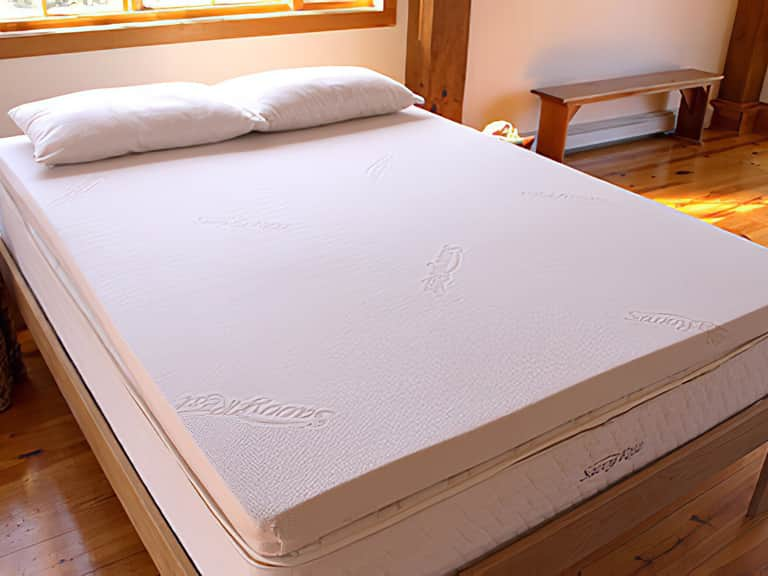
Imagine a mattress topper described as natural Talalay latex inside an organic cotton cover. The description includes two different material claims. The latex claim concerns the rubber layer; the cotton claim concerns the textile casing. To evaluate them, look for documentation corresponding to each material rather than assuming one certificate covers both.
For instance, the Savvy Rest Vitality Latex Mattress Topper is described as having a natural Talalay latex layer and a certified organic cotton stretch-knit casing. Those product details identify two materials and provide a useful starting point for questions. A shopper seeking to verify a specific certification should still consult the current supporting documentation and confirm exactly which component and product scope it covers.
That approach is not an endorsement of a product or a substitute for checking its certificate. It is a way to translate product language into verifiable questions: What is the latex claim? What is the cotton claim? Which standard applies to each? Does the certificate cover this particular item, and is it current?
A buyer’s checklist for organic mattress claims
- Write down the specific material described as organic: latex, cotton, wool, or another component.
- Identify the standard named for that material. GOLS is associated with latex; GOTS is associated with textiles.
- Request the certificate or verifiable certificate details, including issuer and current validity.
- Confirm that the exact model, product type, and relevant facility or supply-chain stage are within scope.
- Find out what parts of the mattress are not covered by the certification.
- Treat “organic,” “natural,” and “certified” as distinct terms, and ask the seller to define each one.
- Evaluate comfort, construction, care, and warranty separately from organic certification.
The bottom line
GOLS and GOTS can make organic mattress claims more legible, but only when their boundaries are respected. GOLS is the relevant standard to investigate for certified latex. GOTS is the standard to investigate for organic textiles and their processing. A mattress may involve both, yet neither acronym automatically certifies every component or the entire finished product.
The most useful label is the one that can be traced to a current certificate with a clear scope. Read the documentation, match it to the material and model, and ask what falls outside it. That small act of precision turns an appealing claim into information a buyer can actually use.
Frequently asked questions
Does GOTS certify an entire mattress?
Not automatically. GOTS is a textile standard. A certificate may cover a textile component or, where its scope explicitly allows, a finished textile product. It does not establish that latex, springs, or every other mattress component is certified.
Does GOLS certify the cotton cover?
GOLS is focused on latex, not cotton textiles. A cotton cover would need its own relevant documentation, such as GOTS certification if the product and certificate qualify.
If a mattress contains certified organic latex, can it be called an organic mattress?
That depends on the exact claim, the applicable rules, and what the certification covers. Do not assume a certified latex layer makes every component organic. Ask the manufacturer to identify the certified materials and provide documentation for the finished product claim.
Are GOLS and GOTS the only labels that matter?
No. They address specific material and processing questions. Other standards may address different properties, but no single label should be treated as a complete account of comfort, durability, emissions, or every aspect of product safety.